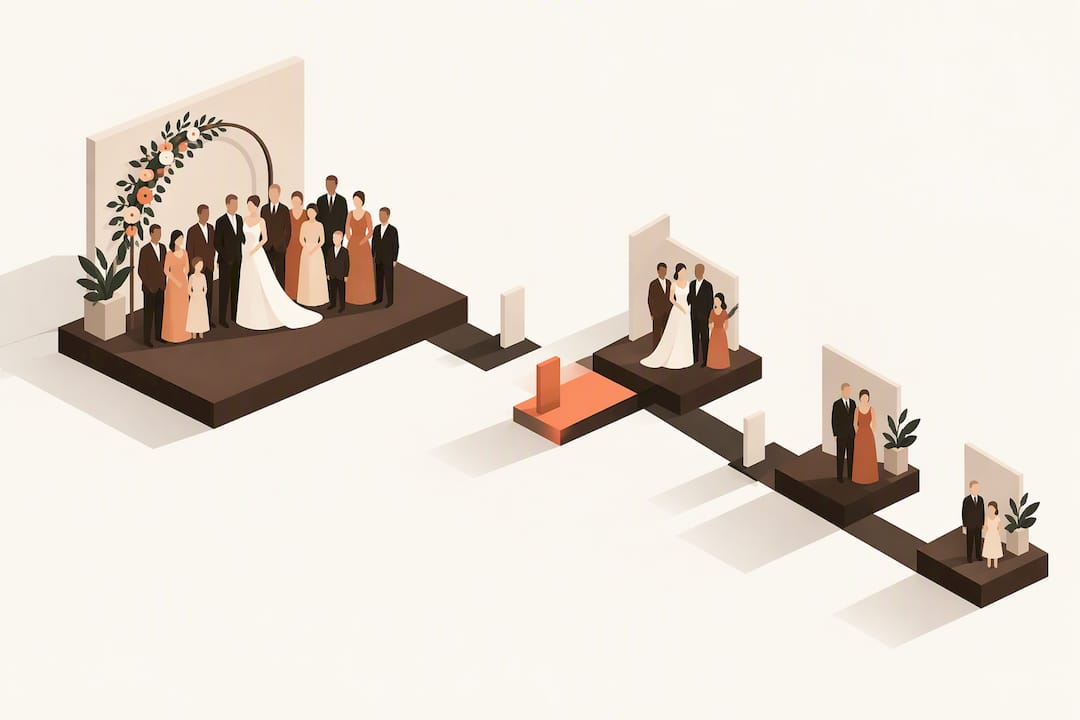
A wedding family photo list is a written plan of exactly which family groupings you want photographed, in what order, with full names attached. The single most important thing you can do is keep your must-have list short, assign one helper per side to round up relatives, and send the finished list to your photographer before the wedding. Most couples need 20 to 40 minutes for this part of the day, depending on list length.
TL;DR:
- Keeping the family photo list short and clearly organized minimizes delays, with 20 to 40 minutes typically needed for the session.
- Prioritize essential groupings such as couple with both sets of parents, siblings, grandparents, and immediate family, limiting extended relatives to one large portrait per side.
- Sequencing shots from grandparents to extended family reduces swap time, with each small group of 2-3 taking about 1 to 3 minutes, longer for larger groups.
- Assigning a designated helper for each family side and using a laminated, printed list enhances efficiency and prevents confusion during the session.
- Include special needs or traditions early in the sequence, and communicate clear decisions about partners, children, pets, and sensitive family dynamics to your photographer beforehand.
Table of Contents
- 1. A Prioritized Sample Shot List You Can Copy
- 2. Sequencing and Timing That Minimizes Swaps
- 3. How to Create and Share Your Family Photo List
- 4. Handling Divorce, Stepfamilies, Mobility, Kids, and Pets
- 5. What Photographer Coverage Usually Includes
- 6. A Printable Day-Of Checklist to Keep Things Moving
- 7. Including Cultural or Religious Family Photo Traditions
- 8. Mixing Candid Shots With Your Posed Family Portraits
- Our Take on Keeping Family Photos Efficient and Meaningful
- How JettLife Approaches Family Photos on Your Wedding Day
- Ready to Book Your Wedding Photography?
- FAQ
- Sources
1. A Prioritized Sample Shot List You Can Copy
Start with a short list of combinations you would genuinely regret missing, then add extras only if time allows. The Knot recommends building your must-haves around parents, siblings, grandparents, stepparents, children, and significant partners, treating extended relatives as optional. A prioritized shot list structure that includes roughly 6 to 12 must-have groupings and 6 to 10 nice-to-have groupings tends to run smoothly without crowding the timeline.
Your must-have list should cover the people you would notice missing from your wedding album years from now:
- Couple with both sets of parents together.
- Couple with each set of parents separately (useful if parents are divorced or remarried).
- Couple with siblings and siblings' spouses or partners.
- Couple with grandparents.
- Couple with immediate family (parents, siblings, grandparents together).
- Couple with the full wedding party.
Once the must-haves are locked in, a nice-to-have list can round out the album without slowing down your must-have shots:
- Extended family clusters, such as aunts, uncles, and cousins grouped by family branch.
- Chosen family or close friends who function like family.
- A quick photo with a pet and its handler.
- Generational shots, such as three or four generations in one frame.
- Couple with godparents or honorary family members.
A template builder from TogetherLens suggests a core list that mirrors this same structure: couple with both sets of parents, couple with each set of parents separately, couple with siblings, couple with immediate family, couple with grandparents, and couple with the wedding party. Rather than listing every aunt and uncle as a separate combination, plan one large extended-family portrait per side. It covers everyone without multiplying setup time.
When writing out each line on your list, use neutral, specific phrasing instead of vague labels. "Couple + Mom + Dad" is clearer than "parents," and including full names next to each grouping helps your photographer and helpers identify people quickly, since full names beside each grouping prevent delays caused by trying to recall who belongs where.
Decide upfront whether partners and children of siblings or cousins are included in each shot. A common approach is to include partners and kids in the big family portrait but keep the core sibling shot to blood relatives only, especially if your sibling group is large. Write that decision directly on the list so nobody has to guess on the day.
2. Sequencing and Timing That Minimizes Swaps
The order you shoot groups in matters almost as much as the groups themselves. A sequencing pattern that starts with grandparents and works down to smaller groupings reduces the number of people swapping in and out between shots, which is where most of the wasted time actually happens.
A practical sequence looks like this: grandparents first (since older relatives tire faster and may need to sit down), then parents, then siblings, then immediate family as a whole, then extended family clusters, and finally the wedding party. Each step adds or removes just a few people rather than reshuffling the entire group, which keeps the line moving.
Timing varies by group size. Revel's guidance on efficient shot lists points to small groups of 2 to 3 people taking roughly 1 to 3 minutes, medium groups of 4 to 8 people taking about 3 to 5 minutes, and large groups of 9 or more people needing 5 minutes or longer once everyone is arranged and checked for stray phones or sunglasses.

These totals assume relatives are already nearby and a helper is actively managing the line. Add extra buffer if your venue requires walking between locations.
Most couples schedule family photos right after the ceremony, since everyone is already dressed and in one place. Some choose to do portraits during a first look instead, which frees up more of the cocktail hour but means coordinating relatives earlier in the day, before some may have arrived. Cocktail hour works if your photography coverage includes a second shooter who can capture candids with guests while the couple finishes formals separately.
3. How to Create and Share Your Family Photo List
Building a list that actually works on the day takes more than jotting down names. WeddingWire's portrait checklist recommends confirming names, attendance, and any sensitive relationship details, like divorce or remarriage, before the list is considered final.
- Collect full names, relationships, and confirmed attendance for every person who might appear in a grouping.
- Mark each grouping as must-have or nice-to-have so your photographer knows what to prioritize if time runs short.
- Assign one wrangler per family side, with their phone number listed next to their name and a clear job: locate people and keep the next group within arm's reach.
- Create a printable version for your wranglers and a spreadsheet version, with columns for name, role, phone number, and arrival time, for your photographer's vendor kit.
- Note any accessibility needs, divorced or remarried parents who should be photographed separately, preferred locations, and a rain plan in your photographer notes.
- Send the finished list to your photographer well before the wedding, ideally alongside a completed wedding questionnaire so every detail lives in one place.
A spreadsheet works well for vendors because it can be sorted and searched, while a printed, one-page checklist is easier for a stressed wrangler to glance at in a hallway. Keep both formats in sync so nobody is working off outdated information.
Pro Tip: Print your list in a large, simple font and laminate one copy for each wrangler so it survives a sweaty hand or a sudden rain shower.
4. Handling Divorce, Stepfamilies, Mobility, Kids, and Pets
Family photo lists run into trouble fastest when they ignore real family dynamics. The fix is usually to plan around them rather than force everyone into one frame.
When parents are divorced or remarried, default to separate photos rather than a single combined shot. Revel's guidance on prioritized lists specifically recommends defaulting to separate parent photos when remarriage or divorce complicates a combined grouping, which avoids an awkward negotiation in front of a camera. Stepparents can be included in their own grouping or folded into the immediate-family shot, depending on the relationship.
Grandparents and other older relatives should be seated or staged early, before fatigue sets in, and their photos should happen near the front of your sequence. A folding stool tucked near the photo area makes this easier without drawing attention.
Children do best with short, specific strategies: a snack on hand, a small toy as a quick reward, or simply a tight time window before patience runs out. Don't schedule a child-heavy group last on your list.
Pets need exactly one dedicated photo with a handler standing just out of frame, ready to step in the moment the shot is taken. Chosen family and close friends deserve their own grouping if they're part of your daily life, even if they're not related by blood. When extended family is large or spread across branches, one broad group photo per side, rather than a dozen smaller combinations, keeps the day moving while still including everyone.

5. What Photographer Coverage Usually Includes
Your photography fee typically covers an agreed block of coverage time and a set of deliverables, not unlimited combinations of family groupings. WeddingWire's checklist guidance notes that extra time or a long list of additional combinations may come with added charges, so it's worth confirming costs before the big day rather than after.
Before you finalize your contract, ask your photographer these questions:
- What is the overtime rate if family photos run past the scheduled coverage window?
- Is a second shooter available, and does that change what's included in the base fee?
- What is the typical turnaround time for edited images after the wedding?
- Does the quoted price include a rain-plan or indoor backup location?
- How many total formal groupings does the package assume as standard?
Use your shot list as a negotiating tool rather than an afterthought. Walking into a planning call with a prioritized list in hand lets your photographer tell you honestly whether your expectations fit the time you've booked, or whether you need to add coverage. Get any add-on fees for extra time or extra combinations in writing, attached to your contract, so there's no confusion on the invoice later.
6. A Printable Day-Of Checklist to Keep Things Moving
A short, physical checklist does more to keep your photo session on schedule than any amount of pre-wedding planning alone. Pack these items before the ceremony:
- Two printed copies of the final shot list, one for each wrangler.
- Wrangler contact numbers written at the top of each copy.
- A bottle of water for the wedding party and immediate family.
- A small folding stool for grandparents or anyone who tires quickly standing.
Assign roles clearly: one person fetches the next group while the current group is still being photographed, one person holds any props or signage, and one person calls out names so nobody has to guess who's next.
A prioritized template with a clear sequence and a designated wrangler is the structure most efficiency-focused wedding photographers now recommend for avoiding timeline slippage during formals. The core idea is simple: fewer surprises mean fewer delays.
A wrangler can keep momentum with short, direct scripts: "Smith family, you're up next, please head to the oak tree." "Thank you, bride's siblings, you're free. Groom's siblings, come on over." Keeping the phrasing consistent trains your family to listen for their cue instead of standing around confused.
7. Including Cultural or Religious Family Photo Traditions
Many families expect specific photo moments tied to cultural or religious practice, and these deserve a dedicated line on your shot list rather than an afterthought. A tea ceremony portrait, a blessing from an elder, a specific procession moment, or a ritual object like a unity candle or a ketubah signing can all be treated as their own grouping with a clear time slot.
Talk with your photographer ahead of time about any moments that are sacred, private, or off-limits to photograph, and any that are expected to be documented in full. Some traditions call for specific people to stand in particular positions relative to the couple, so note that detail next to the grouping on your list. If a tradition involves extended family or community elders who aren't part of your core must-have list, consider adding it as a priority nice-to-have, since it may matter more to your family than a generic extended portrait would.
Building these moments into your sequence early, the same way you would prioritize grandparents, keeps them from getting rushed or skipped entirely when the day runs long.
8. Mixing Candid Shots With Your Posed Family Portraits
A shot list keeps your formals organized, but it shouldn't crowd out the candid moments that often end up being everyone's favorites. The posed groupings on your list capture who was there and confirm the relationships that matter to you. Candid photos capture how everyone actually felt that day.
The easiest way to get both is to let your photographer know which blocks of time are strictly for posed formals and which are open for candid coverage, such as during cocktail hour or right before the ceremony. If your coverage includes a second shooter, they can work the crowd for candid moments while the main photographer runs through your list with the wrangler.
You don't need a separate candid shot list. Instead, mention a few specific relationships or moments you'd love captured informally, like a grandmother watching her grandchild walk down the aisle, and let your photographer build around that cue naturally during the parts of the day that aren't scripted.
Our Take on Keeping Family Photos Efficient and Meaningful
The biggest misconception about wedding family photos is that a longer list means a more complete album. In practice, the opposite tends to be true: the couples who end up with the richest, most natural-looking family photos are usually the ones who kept their must-have list short and protected the rest of their timeline for everything else happening that day.
The real risk isn't missing a distant cousin. It's spending 45 unplanned minutes wrangling relatives who don't know where to stand while your reception clock quietly ticks away. A tight, sequenced list with a designated helper solves a logistics problem, not a photography problem, and treating it that way from the start changes how the whole session feels.
— DJ
How JettLife Approaches Family Photos on Your Wedding Day
We build our wedding coverage around the same principle: a short, prioritized list and a clear sequence protect your time without sacrificing the photos that matter. Storytelling sits at the center of how we work, and that starts well before the ceremony, with a pre-event questionnaire that gathers your family groupings, names, and any sensitive dynamics so we walk in already prepared.
On the day, we work directly from your shared shot list and coordinate with your designated helpers to keep formals moving at a pace that fits your actual timeline, not a generic one. We deliver edited photos promptly, so the planning you put into your list translates into a finished gallery quickly, not months later. You can see more about how we approach events on our home page.
Ready to Book Your Wedding Photography?
We know a wedding day moves fast, and your family photo list is only as useful as the team executing it. When you book with us, we start with a wedding questionnaire that captures your shot list, your family dynamics, and your must-haves before we ever show up, so there's no scrambling on the day.

Our Photography and Videography package combines full event coverage with edited delivery soon after, and our Event Photography service covers formals, candids, and everything in between on-location. If you'd rather book photography and videography separately, both are available too. Browse our store to see current packages and get your wedding on our calendar.
FAQ
What family pictures are taken at a wedding?
Most couples prioritize photos of the couple with both sets of parents, with each set of parents separately, with siblings, with grandparents, with immediate family as a group, and with the full wedding party. Extended family, chosen family, and pets are typically treated as nice-to-have additions rather than must-haves.
Is $5,000 too much for a wedding photographer?
Whether a quote feels reasonable depends heavily on your region, coverage hours, and what's included in deliverables, so there's no single right answer. We don't publish a flat wedding package price, but our Photography and Videography service is listed from our store at $600 for combined coverage, with Photography and Videography available separately at $350 each.
How do I organize family photos at a wedding?
Build a short must-have list, sequence groups from largest and most senior relatives down to smaller groupings, and assign one wrangler per family side to gather people quickly. Send the finished list, ideally with full names attached, to your photographer ahead of the wedding.
Are aunts and uncles included in wedding photos?
Aunts and uncles are usually treated as part of extended family rather than the core must-have list, and many couples group them into one large extended-family portrait per side instead of separate combinations. If a specific aunt or uncle relationship matters deeply to you, add that individual grouping to your must-have list by name.
Sources
- The Family Wedding Photos Shot List to Show Your Photographer
- A Wedding Family Portrait Checklist For Your Photographer
- Group wedding photos: a shot list that doesn't take forever — Revel
- Wedding family photo list template & free builder | TogetherLens