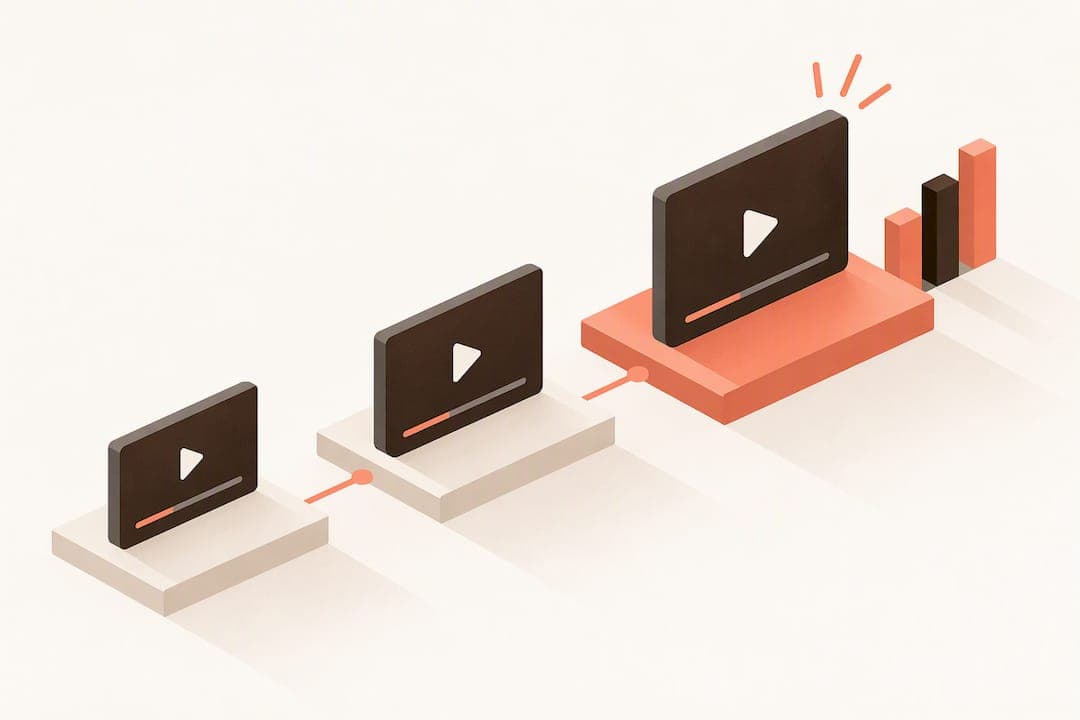
Pick the shortest length that fully delivers the message. For social awareness, aim under 60 seconds. Paid social wants 15 to 30 seconds. Landing pages can hold 60 to 90 seconds. Explainers run 1 to 5 minutes, and conversion or nurture content can stretch from 5 to 30 minutes. Put your call to action at the end for anything under 5 minutes, and earlier for anything longer.
TL;DR:
- Shorter videos under 60 seconds generate the highest engagement for awareness and social content, but may lack depth on the subject.
- Paid social ads should be limited to 15 to 30 seconds to prevent viewers from scrolling past, while organic social content can extend to 60 seconds based on platform norms.
- Longer videos over five minutes require an early placement of the call to action, as engagement significantly drops toward the end.
- For complex offerings or viewers with prior intent, videos up to 15 minutes are justified when structured with clear sections and timestamps.
- Testing different durations, such as 30 versus 60 seconds, for the same message helps identify the optimal length based on watch time and conversions, not just completions.
Table of Contents
- Recommended promo video lengths by marketing goal
- Where should you place your promo video by platform?
- How do you script and trim a promo to its shortest complete length
- What the data says about CTA timing and how to test it
- When does a longer promo video make sense?
- Producer checklist for shipping promo cuts fast
- Match the length to the goal, not the habit
- Get a promo video built to the length that fits your goal
- Sources
- FAQ
Recommended promo video lengths by marketing goal
Duration should follow the job the video is doing, not a house style or a gut feeling. A teaser built to build awareness behaves differently from a webinar preview meant to educate, and the data backs that up clearly.
Wistia's research on marketing video length found that videos under 60 seconds average about a 52% engagement rate, making them the strongest choice for brand awareness and social engagement.
- Awareness (teasers, brand spots): under 60 seconds, built for scroll-stopping impact.
- Engage on social (behind-the-scenes, culture clips): 15 to 60 seconds, tuned to platform norms.
- Educate or explain (how-it-works, feature walkthroughs): 1 to 5 minutes, enough room to unpack a concept.
- Convert or nurture (product demos, case studies): 5 to 30 minutes, for viewers already evaluating.
- Retain or train (onboarding, tutorials): as long as the task requires, since viewers arrive with a specific need.
Under 60 seconds gets you engagement, not necessarily depth. Wistia's State of Video insights show that shorter videos post higher engagement rates while longer videos accumulate more total watch time, meaning a 20-minute demo can still deliver more minutes watched and more conversion opportunities than a slick 30-second spot, provided the structure earns that attention.
The tradeoff is simple: short formats win the scroll, long formats win the sale, once the viewer has already decided to pay attention.

Where should you place your promo video by platform?
Length only works when it matches how people behave on the platform where they see it. Paid placements interrupt an unrelated scroll, so they need to earn attention fast. Organic and search-driven placements meet viewers who already showed intent, so they tolerate more runtime.
- Paid social (Meta, TikTok ads): 15 to 30 seconds, since interruptive formats lose viewers within the first few seconds if the hook is weak.
- Organic social (Instagram, TikTok, Facebook feed): 20 to 60 seconds, matching platform-aligned guidance for casual browsing behavior.
- YouTube: more permissive runtime, since viewers there often arrive with intent to watch, research or compare.
- LinkedIn organic: typically under 3 minutes, reflecting a professional audience that skims but will stay for value.
- Email: a short embedded clip or thumbnail link, usually under 60 seconds, to avoid slowing load times.
- Landing pages: 60 to 90 seconds, per practical guidance from Pictory's promo video breakdown, since visitors there already want more than a glance.
Vertical 9:16 framing suits Reels and TikTok, horizontal 16:9 suits YouTube, and landing page video should stay compressed so it does not slow the page.
How do you script and trim a promo to its shortest complete length
Getting to the right runtime is a writing problem before it is an editing problem. Start with a one-sentence brief: who is the audience, what is the single message, and what is the one action you want them to take. If any of those three needs a second sentence, the video is not focused enough yet.
- Write the hook: the first 3 seconds that state the problem or promise, no throat-clearing.
- Write the value: one clear demonstration or claim that proves the promise.
- Write the CTA: a specific, single instruction, not a vague sign-off.
A natural speaking pace runs close to 75 to 90 words per 30 seconds, according to Zawa's scripting guidance, so a 60-second script should land near 150 to 180 words before edits tighten it further.
Draft the 60-second version first, since it is easier to cut down than to pad up. Then make the 30-second cut by removing the proof beat entirely or compressing two supporting shots into one, keeping the hook and CTA untouched.
Pro Tip: Read your script aloud with a stopwatch before you shoot a single frame. If it runs long at the table read, it will run longer on camera.
What the data says about CTA timing and how to test it
CTA placement is not a style choice, it is a measurable lever. Wistia's State of Video data shows that videos under 5 minutes convert best with the CTA at the end, since viewers who make it that far are primed to act. Videos over 5 minutes should place the CTA earlier, because engagement drops off well before the closing frame and a late CTA simply goes unseen.
Videos over five minutes see a meaningful drop in engagement, which is why longer-format guidance recommends surfacing the CTA before that drop, not after it.
To test this, run one variable at a time:
- A/B test end-CTA versus mid-video CTA on any video over 5 minutes.
- Track watch time, click-through, and conversion separately, not just completions.
- Place proof points (testimonials, results, demos) early in long-form content and near the hook in short-form content, since short videos have no room to bury the strongest evidence.
When does a longer promo video make sense?
Length past the typical promo range is justified when the offering is complex, the viewer already has intent, or the sale needs detailed proof before a decision. A landing page visitor evaluating a service, a prospect watching a demo, or a registrant previewing a webinar has already opted in, so a longer runtime is not a penalty.
For these formats, structure matters more than trimming:
- Open with a 10-second summary of what the video covers, so viewers can decide to keep watching.
- Use chapters or on-screen timestamps so viewers can jump to the relevant section.
- Place a mid-point CTA for anything over 5 minutes, per the engagement drop-off pattern.
- Cut a 20-minute demo into three or four short promotional clips for social distribution, each built around a single moment worth sharing on its own.
Producer checklist for shipping promo cuts fast
A working shot list keeps you from re-recording footage for every duration. Promo and commercial video should be built around storytelling, aiming each project at the specific audience and outcome the client needs, which is the same discipline this checklist follows.
- For each target cut (15, 30, 60, or 90 seconds), define a one-line objective before shooting.
- Capture a 3-shot opening, 2 supporting B-roll shots, and 1 proof moment per production guidance, so every cut has what it needs without a reshoot.
- Lock CTA phrasing in advance so it does not change between versions.
- Confirm captions, music licensing, and brand assets before the edit begins, not after.
Pro Tip: Shoot for your longest planned cut, then edit down. It is far easier to trim footage than to add a shot you never captured.
Match the length to the goal, not the habit

Most teams default to whatever runtime their last video happened to be, rather than asking what this specific goal requires. The rule that holds up across the data is simple: pick the shortest length that fully delivers the message, then test from there.
If you take one action from this, write a 30-second and a 60-second version of your next script, run both, and measure watch time and conversions, not just completion rate. Completion is a vanity number. Watch time and action are the ones that pay the bills.
— DJ
Get a promo video built to the length that fits your goal
JettLife Productions produces promo and commercial video around the same goal-first thinking covered above, sized to your platform and message rather than a default runtime. Projects can be delivered within about 10 business days, which is a common turnaround time for both photography and video work.
If you have a promo, product launch, or event video to plan, get in touch through JettLife's video services page to talk through length, format, and delivery timeline.
Sources
FAQ
How long is a typical promo video?
Most promotional videos run between 15 and 60 seconds for social and ad placements, with 60 to 90 seconds acceptable on landing pages where viewers already show intent. The right length depends on the goal and the channel more than any single standard runtime.
How long should a band promo video be?
A band promo video aimed at social discovery works best under 60 seconds, matching the engagement pattern seen across short promotional content. A longer cut, closer to 1 to 3 minutes, suits YouTube or a website where fans are already seeking more.
Is a 9-minute educational video too long?
Not necessarily, since educational and explainer content can justify longer runtimes when viewers arrive with intent to learn. Engagement does tend to drop past the 5-minute mark, so placing chapters, an early summary, and a mid-video CTA helps hold attention through a 9-minute video.
Is a 3-minute video too long for LinkedIn?
LinkedIn organic video performs best under 3 minutes, so a 3-minute video sits right at the edge of that guidance rather than past it. Trimming toward 90 seconds to 2 minutes typically holds attention better for a professional feed audience.