
Choose a wedding photographer the way you'd choose a business partner: on style, personal chemistry, and whether they run a documented, professional operation. Build a shortlist of four to six candidates, request two to three full wedding galleries from each, and treat contracts, backups, and insurance as seriously as you treat the photos themselves.
TL;DR:
- Full wedding galleries in similar lighting conditions can reveal how photographers handle challenging environments like dim venues or bright outdoor ceremonies.
- Confirm backup plans include multiple off-site copies of images, not just a single memory card or cloud storage, to ensure coverage against equipment failure.
- Expect to pay between four thousand and six thousand dollars for comprehensive packages that include multiple shooters, engagement sessions, and printed albums.
- Book your photographer 12 to 18 months before peak-season Saturday weddings, and act quickly once you’ve chosen your candidate to secure your date.
- Vague answers about backups, insurance, or final deliverables are warning signs; insist on specific details and proof of insurance to avoid risks.
Table of Contents
- How to Choose a Wedding Photographer: Style, Use, and Fit
- What Does a Wedding Photography Package Actually Cost?
- Where Do You Find a Wedding Photographer Worth Interviewing?
- Why Should You Always Ask for Full Wedding Galleries?
- What Questions Should You Ask in a Photographer Consultation?
- What Belongs in Your Wedding Photography Contract?
- What Are the Biggest Red Flags When Hiring a Photographer?
- When Should You Book Your Wedding Photographer?
- Practitioner Notes From DJ at JettLife
- Ready to Book Your Wedding Photography and Videography?
- Sources
- FAQ
How to Choose a Wedding Photographer: Style, Use, and Fit
Before you message a single photographer, figure out what you actually want to look at for the next 30 years. Pull 20 to 30 images you love from real weddings, not styled editorial shoots, and look for the pattern. Are the colors warm and saturated or soft and desaturated? Do you gravitate toward candid, documentary-style frames or posed, editorial compositions? That pattern is your style, whether it turns out to be bright and airy, dark and moody, or a film-inspired look with grain and muted tones.
Your venue and timing narrow this further. A candlelit reception at 9 p.m. photographs very differently under a moody, low-light approach than under a bright, flash-heavy style, so match your aesthetic preference to your actual lighting conditions, not just to Pinterest.
Think about where these images will live. Large-format prints demand different file resolution than an Instagram feed, and a photographer who shoots primarily for social media might not deliver files sized for a 24 by 36 canvas. Ask about this before you book.
Fit isn't only visual. According to WeddingWire, photographers themselves point to a three-part match: similar style, a genuine personal connection, and confidence in the photographer's process. A consultation is your chance to test the second and third parts.
- Notice whether they ask about your relationship and your day, or just recite package prices.
- Pay attention to response time and tone in emails. It often mirrors how they'll communicate on the wedding day.
- Ask how they direct shy or camera-averse couples. A good answer describes technique, not just reassurance.
What Does a Wedding Photography Package Actually Cost?
Wedding photography breaks roughly into four tiers: budget shooters working solo with minimal editing, mid-range professionals offering a second shooter and an online gallery, premium studios with albums and engagement sessions built in, and luxury teams offering multi-day coverage, fine-art prints, and dedicated planners on staff.
survey](https://www.fearlessphotographers.com/blog/356/2025-usa-prices), typical wedding photography packages often range in the mid-thousands, with many falling between four and six thousand dollars. That range covers a lot of ground, which is exactly why comparing quotes line by line matters more than comparing the bottom-line number.
Paste this checklist into every quote you receive so you're comparing the same scope:
- Coverage start and end time, in hours
- Number of shooters included
- Engagement session included or add-on
- Travel fees and how they're calculated
- Sales tax, if applicable in your state
- Delivery format (online gallery, USB, prints) and turnaround time
A modest budget increase tends to buy the most value in three specific places: extra coverage hours (so you're not cut off before the dance floor gets good), a second shooter (who catches your partner's reaction while the main photographer is on you), and a printed album, which is far more expensive to add after the fact than to build into the original package.
Where Do You Find a Wedding Photographer Worth Interviewing?
Four channels consistently surface qualified candidates: wedding vendor directories, venue-preferred vendor lists, real-wedding galleries on photographer websites, and referrals from recently married friends. Venue coordinators are especially useful because they've watched dozens of photographers work the same rooms and lighting.
Here's a workflow that keeps the process from sprawling into forty open browser tabs:
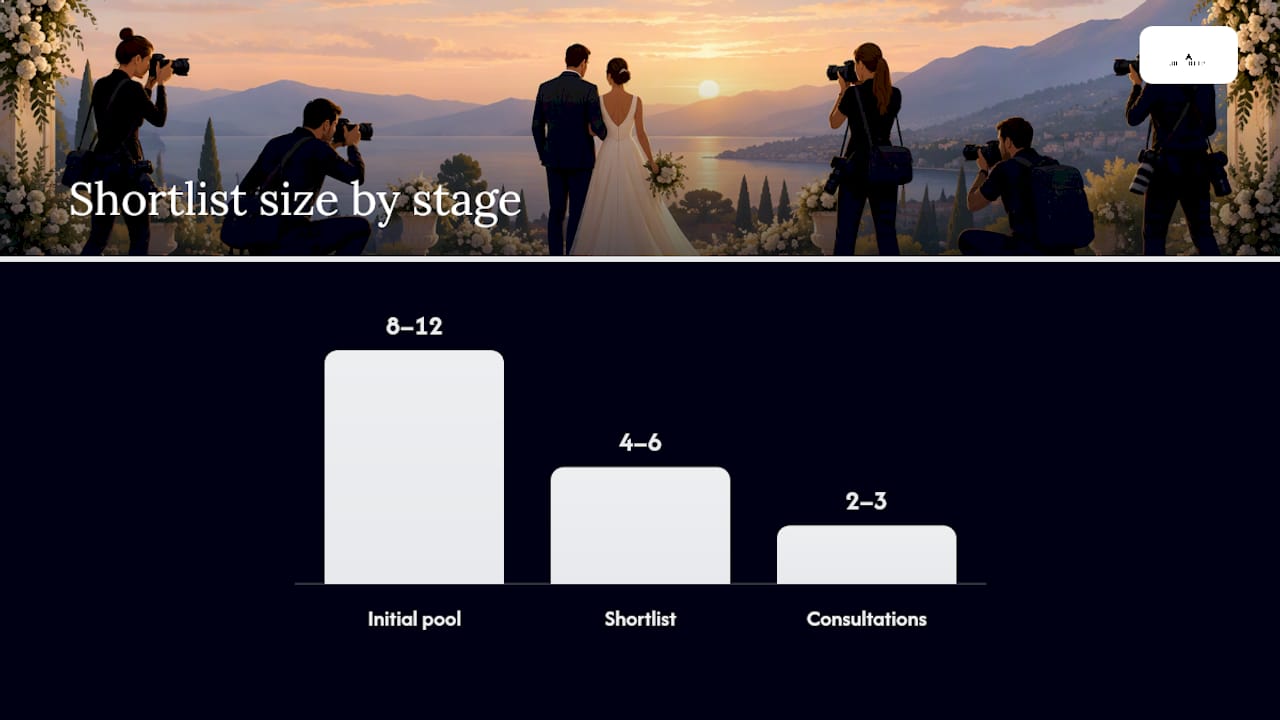
- Collect 8 to 12 names from directories, referrals, and venue recommendations.
- Screen down to 4 to 6 by comparing style consistency and confirming date availability. WeddingWire frames this shortlist size as the practical sweet spot for couples working within a normal engagement timeline.
- Book consultations with 2 to 3 who match both your aesthetic and your budget range.
- Make your final decision within a week of consultations, while impressions are fresh.
Weight full wedding galleries and recent reviews mentioning communication and turnaround time heavily. Discount vague five-star reviews with no detail, and ignore follower counts entirely. A photographer with 4,000 Instagram followers and a documented backup plan beats one with 40,000 followers and no answer about what happens if their camera fails mid-ceremony.
Venue and planner recommendations are a starting point, not a verdict. They know who shows up on time and follows house rules; they don't know if that photographer's editing style matches what you saved to your mood board. Use their list to build your pool, not to skip your own review.
Why Should You Always Ask for Full Wedding Galleries?
Insist on two or three complete wedding galleries before you book anyone, not just a highlight reel. According to The Knot, a full gallery is the strongest test of a photographer's actual craft because portfolio highlight reels are curated from a photographer's entire career. A full gallery shows you one day, start to finish, with all its unpredictable light and moving parts.
Work through each gallery methodically:
- Getting-ready shots: Check for clean composition in cramped hotel rooms, which is a genuinely hard environment to shoot well.
- Ceremony coverage: Look for consistent exposure across a scene that moves from bright outdoor light to a dim indoor altar.
- Family formals: Notice whether large groups look organized or chaotic, and whether everyone's eyes are open.
- Reception and low-light dancing: This is where weak photographers fall apart. Grainy, blurry, or flash-washed dance floor shots are a real warning sign.
- Detail shots: Rings, invitations, and table settings show attention to the small stuff.
Judge the gallery as a narrative rather than a slideshow of separate hero images. The Knot's guidance treats full-gallery review as the best way to see whether quality holds up as light and crowd conditions shift throughout the day, and that consistency across 400 to 800 images tells you far more than any ten perfect frames.
If your wedding has specific conditions, a dark barn venue, a beach ceremony at noon, a winter outdoor portrait session, ask specifically for galleries shot in similar circumstances. Photographers who've solved that exact lighting puzzle before will have examples ready; ones who haven't may get vague or redirect you to a different, easier gallery.
Pro Tip: Review galleries on a laptop or tablet, never just a phone screen. Skin tones, exposure banding, and editing inconsistencies that are invisible on a 6-inch screen become obvious on anything larger.

What Questions Should You Ask in a Photographer Consultation?
Walk into every consultation with the same core list, because comparing identical questions across candidates is the only way to compare answers fairly.
- Will you personally photograph our wedding, or will an associate shoot it?
- What's your substitution policy if you're unable to shoot due to illness or emergency?
- How many hours of coverage are included, and what's the overtime rate?
- Do you work with a second shooter, and is that built into this package or an add-on?
- What camera and lighting backups do you bring on the wedding day?
Brides recommends confirming exactly these points before booking: availability, who shoots the wedding, coverage hours, second-shooter arrangements, and the emergency substitution plan, since the person who signs your contract isn't always the one behind the camera.
Once you've covered logistics, move to deliverables:
- How many edited images will we receive, roughly?
- What's your turnaround time for the full gallery, and do you send sneak peeks?
- What file formats do we get, and do we retain printing rights?
- Have you shot at our venue before, or will you scout beforehand?
- How do you handle a large or complicated family-photo list?
Listen for specificity. A photographer who says "we carry two backup camera bodies and a second flash on every shoot, and my associate Sarah covers for me if I'm ever hospitalized" is giving you a real answer. One who says "don't worry, that's never happened" is not. Vague answers about backups, deliverables, or turnaround deserve a direct follow-up question. If the second attempt is still vague, that's information too.
What Belongs in Your Wedding Photography Contract?
A signed contract is where good intentions become enforceable promises. According to Professional Photographers of America (PPA), read the complete agreement before paying anything, and confirm it specifies deliverables, image quantity, delivery format, timing, and usage rights. State contract laws vary, so don't assume a generic template covers your specific situation.
Your contract should spell out, in writing:
- Exact coverage hours and overtime terms
- Number of shooters attending
- Approximate image count and delivery format (digital gallery, USB, prints)
- Turnaround time for the final gallery
- Usage rights: can you print anywhere, and can the photographer use your images for their own marketing?
- Cancellation and rescheduling terms, including deposit refund conditions
- The name of the photographer who will shoot your wedding, not just the studio's name
Data protection deserves its own line of questioning. PPA's backup guidance recommends more than one off-site backup method, including cloud storage or separately stored physical copies. "The memory cards are safe" is not a backup plan; it's a single point of failure. Ask specifically how many backup copies exist and where they're stored.
If your venue requires vendor insurance, which many do, ask for a certificate of general liability insurance well before the wedding, not the week of. This protects the venue and, indirectly, you.
Before you send a deposit, cross-check the signed contract against everything discussed in your consultation. If the contract is silent on something you were promised verbally, get it added in writing before you pay a cent.
What Are the Biggest Red Flags When Hiring a Photographer?
Some warning signs should stop the process cold. Watch for photographers who won't share full wedding galleries, only curated highlights, along with anyone who avoids putting terms in a written contract, gives evasive answers about backup equipment or insurance, or quotes a price dramatically below everyone else in your area.
If you spot one of these:
- Ask a direct follow-up question and see if the answer improves.
- Request a specific contract amendment if a verbal promise isn't written down.
- Remove them from your shortlist if the evasiveness continues after a second ask.
Verification is simple: request a couple of named references from recent clients, ask for a gallery shot in conditions similar to your venue, and ask for proof of insurance if your venue requires it. A professional operation produces these documents without friction. Hesitation itself is a data point.
When Should You Book Your Wedding Photographer?
Book 12 to 18 months ahead for a peak-season Saturday wedding, according to Bespoke Bride, and roughly 6 to 12 months out for off-peak dates or weekday weddings. Friday and Sunday weddings often have better photographer availability than Saturdays.
Once you've chosen someone, move fast:
- Sign the contract and pay the deposit, standard practice is 25 to 50% upfront, with the balance due before or on the wedding day.
- Send your venue address and rough timeline as soon as it's finalized.
- Complete any wedding-day questionnaire your photographer sends.
- Schedule your engagement session if one's included.
- Confirm arrival time, key shot priorities, and your family-photo list at least a month out.
A collaborative timeline conversation is where an experienced photographer earns their fee, particularly around family formals, which eat more time than couples expect.
Practitioner Notes From DJ at JettLife
The mistake I see most often is couples falling in love with a photographer's ten best Instagram posts and never asking to see a full wedding gallery. Those ten posts tell you nothing about how someone handles a rainy ceremony or a reception that runs an hour behind schedule. Ask for the whole day, every time.
The second mistake is under-specifying backups. "We'll be fine" is not an answer you should accept from anyone handling the only record of your wedding day.
On our end, the habits that save the most time are boring but effective: a written family-photo list organized by group, built-in timeline buffers for the inevitable delays, and a shot list agreed on before the ceremony starts. Combined with a 10-business-day turnaround on delivery, those habits are what actually make a wedding day run smoothly, not just look good in photos afterward.
— DJ
Ready to Book Your Wedding Photography and Videography?
Some studios offer storytelling-driven wedding coverage with the option of editing and delivering photos and video within roughly 10 business days, which is faster than the six to eight weeks common across the industry. That turnaround means your gallery is ready while the day is still fresh, not months later.

We offer standalone Photography and Videography, or a combined Photography and Videography package for couples who want both angles of their day captured. When you reach out for a quote, come prepared with your date, venue, guest count, and a handful of style reference images so we can confirm fit quickly. You can review our approach and past client feedback on why couples choose us for their wedding, and get ahead of the planning process by filling out our wedding questionnaire now. Ready to check your date? Visit our event photography page to start the conversation.
Sources
This guide draws on published wedding-industry guidance rather than opinion alone. The Knot's reporting on style definition and full-gallery review shaped the portfolio and discovery sections. PPA's contract and backup guidance informed the contract and data-protection checklists. Brides and WeddingWire supplied the consultation question framework and shortlist sizing. Pricing benchmarks come from Fearless Photographers' 2025 survey, and booking-timeline advice comes from Bespoke Bride.
- How to Choose a Wedding Photographer to Capture Your Big Day
- How to Choose a Wedding Photographer, According to Photographers
- Questions to ask your photographer before booking
- PPA contract guidance
FAQ
How Do You Choose a Wedding Photographer?
Start by defining your visual style from images you actually love, then build a shortlist of four to six photographers and request full wedding galleries, not just highlight reels, from each. Interview two to three finalists about backups, contracts, and deliverables before booking, since WeddingWire frames style, personal connection, and process confidence as the three factors that matter most.
Is $3,000 Too Much for a Wedding Photographer?
Not necessarily. Fearless Photographers' 2025 survey puts the average U.S. wedding package around $5,800, with a common range of $4,000 to $5,500, so $3,000 often sits at the budget end. What matters more than the number is what's included: coverage hours, shooter count, and delivery format all shift what a fair price looks like.
How Can You Tell If a Wedding Photographer Is Good?
Ask for two or three complete wedding galleries and check consistency across getting-ready shots, ceremony light, family formals, and low-light reception dancing, since a curated highlight reel hides weak spots. Pair that review with direct questions about backup equipment, insurance, and contract terms, since PPA treats operational answers as trust signals every bit as important as creative style.
What Should Be in a Wedding Photography Contract?
Your contract should name the photographer who will actually shoot your wedding, spell out coverage hours, image count, delivery format, and turnaround time, and clarify usage rights and cancellation terms. PPA's contract guidance recommends reading the full agreement before paying, since state laws around these terms vary.
How Much Does JettLife Charge for Wedding Photography?
JettLife's Photography package is $350 one-off, Videography is $350 one-off, and a combined Photography and Videography package runs $600 one-off, all listed on the store page. Event-specific photography and videography are billed at $350 per hour through the event photography page.