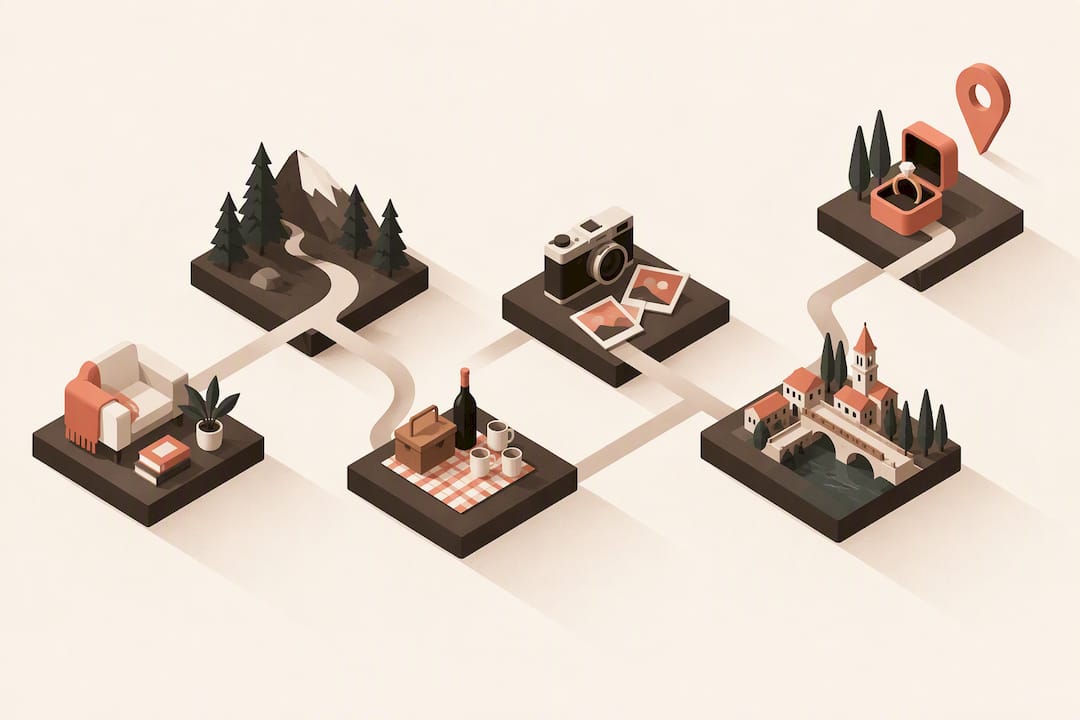
Here are creative, meaningful, and fun engagement photo ideas you can adapt to capture your relationship authentically. This guide groups ideas by theme, then walks through the practical pieces, lighting, wardrobe, poses, and a shot list, so you can turn inspiration into a plan you actually hand to your photographer.
TL;DR:
- Shooting during golden hour or in open shade enhances natural warmth and reduces shadows, making the photos more flattering.
- Selecting meaningful locations and activities creates an emotional story that resonates more than generic backdrops.
- Keeping outfit changes simple and layered ensures variety without disrupting the relaxed flow of the session.
- Incorporating personal props, pets, or shared activities brings authenticity and a unique touch to the photos.
- A well-planned shot list and timing, including wide, medium, and close-up shots, improve the flow and cohesion of the gallery.
Table of Contents
- 1. Idea categories to match your style
- 2. Picking the right location and time of day
- 3. What to wear and how to style the shoot
- 4. Poses and prompts that photograph naturally
- 5. Making it personal with props, pets, and shared activities
- 6. A sample shot list and timeline for your session
- 7. Why hiring a pro changes the results
- 8. How to prepare and relax before the shoot
- 9. Using storytelling to build a cohesive gallery
- 10. Considering cultural or personal traditions
- Prioritize authenticity over trends
- Ready to bring these ideas to life
- FAQ
- Sources
1. Idea categories to match your style
The best engagement photos usually come from a theme that fits how you actually spend time together, not a trend you saw once and liked. Scan these categories, pick one or two that sound like you, and build the rest of the session around them.
- Iconic backdrops: a city skyline at dusk or a ferris wheel at a local fair gives the album a sense of place. Tip: shoot wide to let the backdrop breathe, then move in close for a second set against the same scene.
- Activity or date shoots: a picnic, a cooking session, or a coffee run recreates an actual date instead of a posed event. Editorial guides note that activity-driven shoots feel more like a date than a staged shoot, which tends to produce more natural interaction. Tip: let the activity run for real, snacks and all, so the laughs are genuine.
- Travel or destination sessions: a favorite weekend town or a trip built around the shoot works if travel is part of your story. Tip: build in a buffer hour for weather or transit delays.
- At-home cozy sessions: your actual living room, kitchen, or porch, shot in soft morning light. Tip: tidy the space but leave a few personal objects in frame, like a coffee mug or a stack of books.
- Hobby-first shoots: surfboards at the beach, a crate of vinyl records, a climbing wall, whatever you already do for fun. Tip: use the hobby as a prop, not a backdrop, so you are interacting with it, not posing next to it.
- Seasonal themes: fall foliage, a snowy woodland trail, or the first bloom of spring. Tip: match wardrobe texture to the season, wool and flannel for fall, light cotton for spring.
- Nature and adventure: a hiking trail, a waterfall, or a quiet overlook. Tip: schedule around trail traffic and check if the location needs a permit.
- Pet-inclusive sessions: your dog or cat joins for part of the shoot. Tip: plan a short, dedicated block so the pet does not get worn out before the couple portraits.
- Editorial or fashion-forward shoots: structured outfits, dramatic lighting, a styled set. Tip: keep poses architectural, straight lines and strong angles, to match the mood.
- Black and white or classic sessions: timeless, minimal distraction, built around expression rather than color. Tip: ask your photographer to deliver a few frames in black and white alongside the color set.
Real-couple galleries and curated idea lists both lean on personal locations and shared activities over generic backdrops, which is worth keeping in mind as you narrow your list down to the two or three ideas that matter most to you.
2. Picking the right location and time of day
Light shapes a photo more than almost any other factor, so settle on timing before you settle on wardrobe or poses.
- Golden hour, roughly 45 to 60 minutes before sunset or after sunrise, gives soft, directional light that reduces harsh shadows and adds warmth, which is why it is widely treated as the most flattering natural light) for portraits.
- Open shade (a tree line, a building's shadow, a covered porch) works well at midday when golden hour is not practical, since it avoids the harsh overhead shadows that direct sun creates.
- Overcast days act like a giant softbox, spreading light evenly across the frame, a solid backup if your date gets rained out.
- Night shots under string lights, a carnival marquee, or a city skyline trade natural warmth for a more cinematic, moody feel.
- Weigh a personally meaningful spot (your first date's coffee shop) against a visually iconic one (a skyline or a well-known trail): the first photographs better emotionally, the second photographs better technically. Check ahead for permit requirements or peak crowds at popular public locations.
3. What to wear and how to style the shoot
Pick colors that complement each other rather than match exactly: a rust sweater next to a cream dress reads better on camera than two people in identical navy. Layer in texture, knit, denim, suede, so the images have depth even in a single color family.
- Wear shoes you can actually walk in, especially for hikes or cobblestone streets.
- Choose outfits that allow movement: a flowing skirt, a jacket you can take off, nothing so fitted it restricts a spin or a walk.
- Pack one backup layer in case of wind or temperature swings.
- Ask for black and white or moody color grading on a handful of favorites if you want a timeless set alongside the vibrant ones, a common request for couples who want variety in the final gallery.
Pro Tip: Lay both outfits out together before the shoot and photograph them side by side on your phone. If they clash in a thumbnail, they will clash in print.
4. Poses and prompts that photograph naturally
Posed-but-not-stiff is the sweet spot, and a few simple prompts get you there faster than instructions like "look natural."
- Walk and talk: stroll together while chatting about something real, your photographer shoots from a few steps ahead.
- Forehead kiss: a quiet, low-key moment that reads as intimate without feeling performative.
- Slow spin: one partner spins the other, catches the motion and the laugh that usually follows.
- Whisper and cuddle: lean in like you are sharing a secret, hold for a beat.
- Look-away laugh: one partner looks at the camera, the other looks away laughing, breaks the symmetry of a standard pose.
Mix wide shots (the full scene), medium shots (waist up), and tight shots (hands, faces, the ring) so the final gallery has rhythm instead of ten versions of the same frame, a pairing that pose guides consistently recommend for a balanced set. Practice one or two of these at home beforehand and tell your photographer which ones feel natural to you.
5. Making it personal with props, pets, and shared activities
- Bring props tied to what you actually do: a surfboard, a packed picnic basket, a crate of records with a portable speaker.
- If your pet is joining, bring a leash, treats, and ideally a second person to handle them between shots so you can stay focused on each other.
- Keep pet-focused time short and early in the session, before the energy (yours or theirs) runs low.
- Activity shoots like cooking dinner together or browsing a bookstore work best when you let the activity happen instead of freezing mid-motion for the camera.
6. A sample shot list and timeline for your session
A 45 to 90 minute session covers more ground with a loose plan than with no plan at all.
- Wide establishing shot of the full location.
- Walking shot, hands linked, shot from the side.
- Close-up of your hands or the ring.
- Candid laugh, prompted by an inside joke.
- Forehead kiss or quiet embrace.
- Medium shot against your chosen backdrop.
- Prop or activity shot (cooking, picnic, hobby item).
- Outfit-change portrait if you planned a second look.
- Golden hour silhouette or backlit shot.
- One playful, unposed moment as you wrap up.
Block your timeline into roughly 20 minutes per location, 10 minutes for an outfit change, and a 10 to 15 minute buffer for traffic or weather. Before you go, pack any permits you need, your props, a spare outfit, and a phone loaded with music to help you both loosen up between shots.
7. Why hiring a pro changes the results
A professional brings more than a camera: they manage light on the fly, read your dynamic as a couple, and compose frames you would not think to set up yourself. Fast, edited delivery also means you get a usable gallery in days, not months.
- Ask to see a full gallery, not just a highlight reel, so you know what a typical session looks like start to finish.
- Ask whether they have shot at your planned location before.
- Confirm turnaround time and what's included in delivery (raw files, edited set, web-ready sizes).
- Ask about their backup plan for weather or lighting changes.
8. How to prepare and relax before the shoot
The couples who look the most natural on camera are usually the ones who spent the least time worrying about looking natural. A short prep routine beats a long one.
Eat beforehand so nobody is running on an empty stomach, and drink water, especially if the shoot is outdoors in heat or cold. Do a trial run of hair and makeup a day or two early rather than the morning of, so you are not rushing right before your photographer arrives.
Arrive 10 to 15 minutes before your call time so you are not catching your breath in the first frames. Put your phone on silent once the session starts, not just quiet, so a notification does not pull your attention mid-pose.
The single most useful thing you can do is talk to each other, not the camera. Bring up a shared memory, a bad pun, or plans for the wedding itself. Photographers are trained to catch the reaction, not stage it, so give them something real to catch. If nerves creep in, a short walk together before the first shot, away from the camera, tends to reset the mood better than a pep talk.

9. Using storytelling to build a cohesive gallery
The strongest engagement albums read like a short story, not a stack of unrelated pretty pictures. That usually means choosing a location, an activity, or an object that means something specific to your relationship, and letting every shot in the gallery connect back to it.
If you met at a coffee shop, start there, move to a walk through the neighborhood where you had your first date, and close with a golden hour portrait somewhere that feels like your future. If a specific object matters, a record player, a travel map, a dog you adopted together, let it reappear across a few frames instead of showing up once and disappearing.
Sequence matters too. A gallery that opens wide, narrows into candid medium shots, and closes on a tight, quiet portrait feels like it has an arc, even if none of the individual photos are posed that way. Share the "why" behind your chosen locations or props with your photographer ahead of time so they can shape the sequence around it instead of guessing afterward.

10. Considering cultural or personal traditions
Engagement photos are a good place to work in a tradition that matters to your family or culture, whether that is a specific garment, a ceremony element, or a location tied to your background. A couple might shoot in traditional dress for part of the session and in everyday clothes for the rest, giving the gallery both a formal and a candid side.
If a tradition involves specific colors, objects, or gestures, mention it to your photographer early so they can plan framing and timing around it, rather than trying to fit it in at the last minute. The same goes for personal rituals that are not cultural in the broad sense but matter to you two specifically, a song that was playing when you met, a recipe you always cook together, a spot you return to every anniversary. These details are often what make an engagement gallery feel unmistakably yours rather than interchangeable with anyone else's.
Prioritize authenticity over trends
Pick one or two ideas that actually mean something to you, not everything on a trend list. Share a simple mood board with your photographer, practice a couple of natural prompts, and let the rest happen on its own.
— DJ
Ready to bring these ideas to life
Each session can be built around your story, with personalized planning and an edited turnaround designed to avoid long waits for your photos. A booking conversation typically covers your portfolio preferences, a shared shot list, and which services fit your plans.

- Review sample galleries and packages on the JettLife store.
- Ask about event-specific photography options on the event photography page.
- Use the wedding questionnaire to organize your shot list and preferences before your first call.
Get in touch through the JettLife Productions site to check availability for your engagement session.
FAQ
What are some unique engagement photo ideas?
Unique ideas usually come from personalizing a theme you already like: shoot at your first-date coffee shop, bring a hobby prop like a surfboard or a crate of records, or build the session around an activity like cooking together. The most memorable sessions tend to use a meaningful location over a generic one.
Are engagement photos worth it?
Most couples find engagement photos worth the cost because they double as a practice run with your photographer before the wedding and give you images for save-the-dates or a guest book. They also help you get comfortable in front of a camera, which tends to make wedding-day photos feel more natural too.
When is the best time of day for engagement photos?
Golden hour, about 45 to 60 minutes before sunset or after sunrise, gives the softest and most flattering light for outdoor portraits. Overcast days or open shade work as solid alternatives if your schedule does not line up with golden hour.
How many outfit changes should we plan for an engagement shoot?
One or two outfit changes is the general guideline, enough for variety without eating into shooting time or making the session feel rushed. Editorial photography guides suggest keeping changes simple so the energy of the shoot stays relaxed.
How do we include our pet in engagement photos?
Bring a leash, treats, and ideally a friend or family member to handle your pet between shots so you can stay present with each other. Plan a short, dedicated block early in the session, since pet-focused shoots tend to go more smoothly before anyone's energy runs low.
Sources
- 70 Engagement Photo Ideas from Real Couples — Brides
- The Absolute Best Engagement Photo Ideas We've Ever Seen — The Knot
- 25 Engagement Photo Poses to Capture Your Love — Minted